Correct unfolding even for complex parts, the system flags when it's uncertain
Sheet metal parts are unfolded via AAG bend-graph and rigid unfold. DIN 6935 K-factor is calculated per bend. When a part is hard to unfold with high confidence, the system flags it, you never guess in silence.
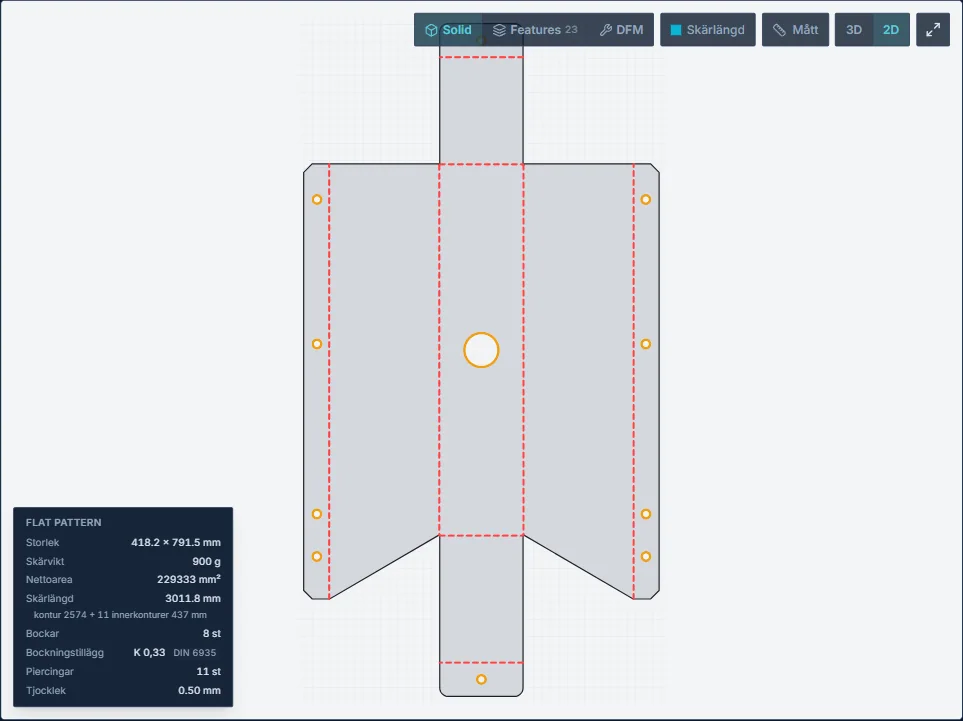
From 3D geometry to a correct blank
Every bend is identified, unfolded in the right order and measured with an individual K-factor. The result is rendered as SVG with bend lines, dimensions and DFM markers.
Six layers of geometry understanding
Most tools handle simple flat sheets. Glintify handles the parts real engineers face every day, with T-joints, hem bends and formed features.
AAG bend-graph
The part's entire bend topology is analyzed via an Attributed Adjacency Graph. The system finds the right unfold order even when bends meet at T-joints and complex corners.
Rigid unfold, complex geometry
Panels are unfolded with a strict rigid-body transform based on the cross-product of adjacent surface normals. The anti-foldback rule prevents panels from colliding during unfolding.
T-joints and hem bends
T-joints are healed with collinear interval parity. Hem bends open correctly, the bend angle is read from the cylinder's arc-sweep, not the included angle, which otherwise gives a 0° error.
Formed features in 2D
Press, emboss and louver features are projected down onto the carrier panel in the flat pattern. Vent lines, slots and through-cuts land in the right place, no phantom contours.
Multi-blank per component
Assemblies with multiple sheet components are unfolded per blank. Each blank gets its own flat pattern, DFM check and cost calculation.
SVG rendering with dimension annotation
The flat pattern is rendered as SVG with dimensions, bend lines, cutouts and DFM warnings drawn in. Directly usable for quotes, nesting and verification.
The system flags when it's uncertain
Most systems always give an answer, and you never know if it's right. Glintify calculates confidence per part and marks the result as high or low. You never guess in silence.
flatPatternConfidence = "high" | "low"
Calculated automatically per part. Shown in SmProperties and quote data.
All panels are flat, the bend topology is unbroken and T-joints have been healed. The unfold is deterministic.
The part contains formed features, complex bridge configurations or bends with unusual topology. The engineer should verify the flat pattern manually.
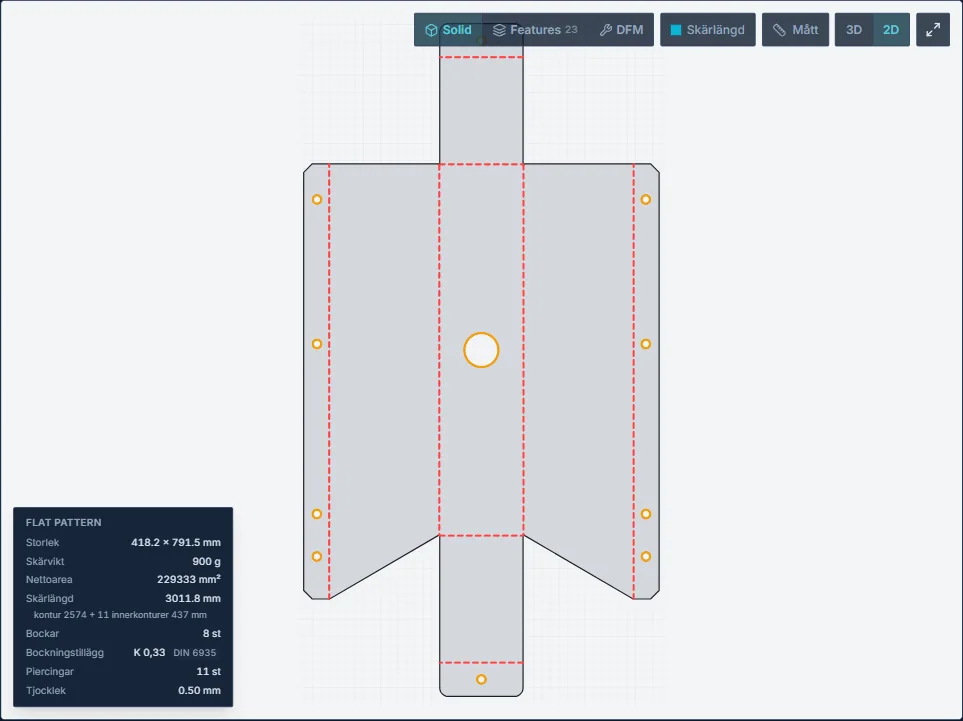
DIN 6935 K-factor per bend
Bends are unfolded with an individual K-factor based on the r/t ratio. No generic rule of thumb, every bend on the part gets its correct factor.
K-factor (DIN 6935)
K = 0,65 + 0,5 × log₁₀(r/t)
r = inner radius (mm) · t = sheet thickness (mm)
The bend allowance is calculated per bend and summed into the total blank dimensions.
DIN 6935, German industry standard for sheet metal unfolding
DIN 6935 is a German industry standard for calculating bend allowance in sheet metal unfolding. The standard is widely used and defines how the K-factor is derived from the r/t ratio per bend. Glintify implements it fully, every bend on the part is calculated individually, not with an average.
Standard
DIN 6935 (German industry standard)
K-factor
K = k/2, k = 0.65 + 0.5 × log₁₀(r/t)
Per bend
Yes, individual factor
Material support
All sheet materials
Confidence
high / low per part
Bridge detection that affects the price
Sheet tabs held by vent lines (bridges) are identified and classified separately. That gives a correct cut length and correct cost calculation, not a guess.
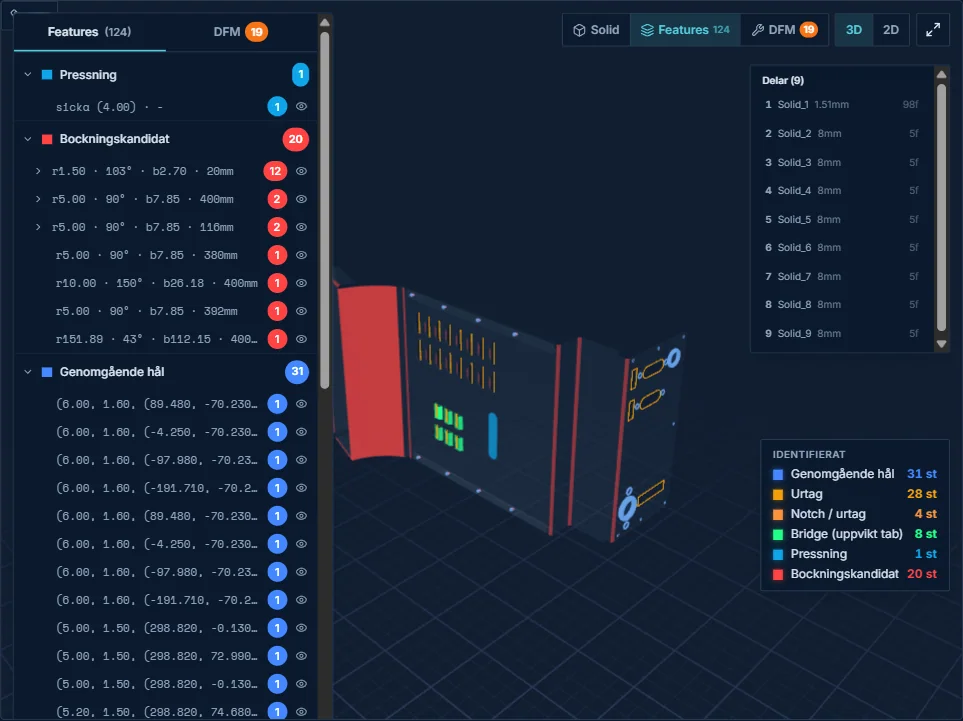
Multiple components, unfolded per blank
Assemblies with multiple sheet components are unfolded per blank. Each component gets its own flat pattern, its own DFM checks and its own cost calculation.
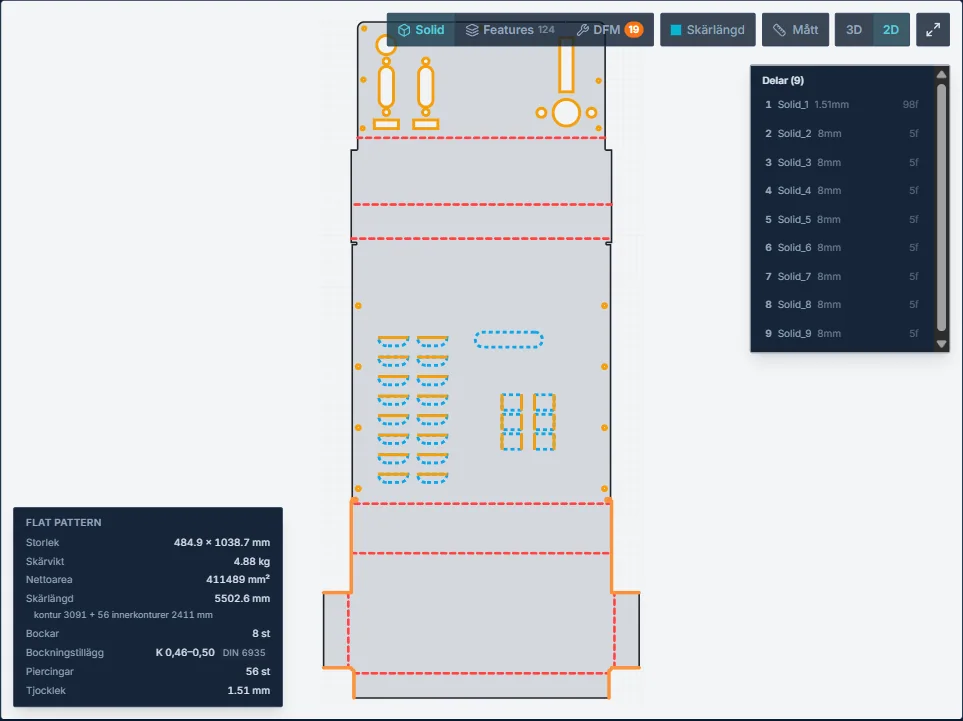
Flat pattern is part of the whole chain
Unfolding and DFM go together. See how the DFM checks run on the flat pattern, and how costing and CAD analysis build on it.
See flat pattern on your own CAD file
Upload a STEP file from a typical part. We analyze the geometry live, show the flat pattern with a confidence signal and how cut length and price are built up.
Book an analysisWant the unfold math, or which K to use when the drawing has no value? K-factor per DIN 6935 · K-factor per bend in quoting